Kinosternon flavescens
| Kinosternon flavescens[1] | |||
| (Agassiz, 1857) | |||
 | |||
| Systematyka | |||
| Domena | |||
|---|---|---|---|
| Królestwo | |||
| Typ | |||
| Podtyp | |||
| Gromada | |||
| Rząd | |||
| Podrząd | |||
| Rodzina | |||
| Podrodzina | |||
| Rodzaj | |||
| Gatunek |
Kinosternon flavescens | ||
| Synonimy | |||
|
| |||
| Kategoria zagrożenia (CKGZ)[3] | |||
 | |||
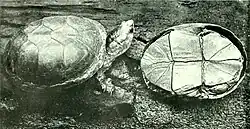
Kinosternon flavescens – gatunek gada z podrzędu żółwi skrytoszyjnych i rodziny mułowcowatych (Kinosternidae).
Morfologia
Karapaks oliwkowy, oliwkowożółty lub oliwkowoszary. Brzegi karapaksu są czasami bardziej żółte. Głowa i kończyny są podobnie ubarwione jak karapaks, lecz z wyraźniej zaznaczonym kolorem żółtym. Żyją ponad 10 lat[4]. Długość ciała wynosi 8–16,8 cm[5][6].
Występowanie
Występuje w Ameryce Północnej na terenie USA i Meksyku[2][7].
Ekologia
Samice w maju lub czerwcu składają od 1 do 10 jaj barwy białej, kształtu eliptycznego, niewielkich rozmiarów – 23–31 mm długości i 14–18 mm szerokości[8]. Młode klują się po 90 do 118 dniach. Odżywia się ślimakami, rakami, insektami, robakami i drobnymi rybami.
Ochrona
Gatunek ten od 2023 roku jest objęty załącznikiem II konwencji waszyngtońskiej (CITES)[9][10] i aneksem B UE[10].
Przypisy
- ↑ Kinosternon flavescens, [w:] Integrated Taxonomic Information System (ang.).
- 1 2 3 4 5 6 P. Uetz & J. Hallermann, Kinosternon flavescens, [w:] The Reptile Database [online] [dostęp 2024-02-22] (ang.).
- ↑ Kinosternon flavescens, [w:] The IUCN Red List of Threatened Species (ang.).
- ↑ Patricia Pope Bartlett, Billy Griswold, Richard D. Bartlett: Reptiles, amphibians, and invertebrates: an identification and care guide. s. 1832.
- ↑ Hobart Muir Smith, Edmund D. Brodie Jr, David T. Dennis, Sy Barlowe: Reptiles of North America: A Guide to Field Identification (Golden Field Guide from St. Martin's Press). s. 26.
- ↑ Robert A. Stebbins: A field guide to western reptiles and amphibians. 2003, s. 247–248.
- ↑ R. Midtgaard: Kinosternon. RepFocus. [dostęp 2020-09-25]. (ang.).
- ↑ Grzimek's Animal Life Encyclopedia, Volume 7, Reptiles, s.125
- ↑ Krzysztof Lis, Lista gatunków, które weszły na listę CITES w 2023 roku [online], Terrarium [dostęp 2023-02-03] (pol.).
- 1 2 Species+ [online], speciesplus.net [dostęp 2023-12-15].
Bibliografia
- Hobart Muir Smith, Edmund D. Brodie Jr, David T. Dennis, Sy Barlowe: Reptiles of North America: A Guide to Field Identification (Golden Field Guide from St. Martin's Press). Golden Guides from St. Martin's Press, 1982. ISBN 1-58238-123-2.
- Robert A. Stebbins: A field guide to western reptiles and amphibians. Boston: Houghton Mifflin, 2003. ISBN 0-395-98272-3.
- Patricia Pope Bartlett, Billy Griswold, Richard D. Bartlett: Reptiles, amphibians, and invertebrates: an identification and care guide. Hauppauge, NY: Barron's, 2001. ISBN 0-7641-1650-9.
- Grzimek's Animal Life Encyclopedia, 2nd edition. Volume 7, Reptiles, edited by Michael Hutchins, James B. Murphy, and Neil Schlager. Farmington Hills, MI: Gale Group, 2003