Malimbus
| Malimbus[1] | |||||
| Vieillot, 1805[2] | |||||
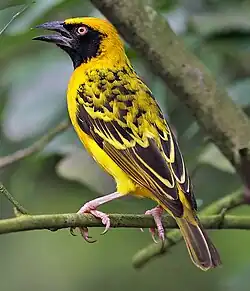 Wikłacz zmienny (M. cucullatus) | |||||
| Systematyka | |||||
| Domena | |||||
|---|---|---|---|---|---|
| Królestwo | |||||
| Typ | |||||
| Podtyp | |||||
| Gromada | |||||
| Podgromada | |||||
| Infragromada | |||||
| Rząd | |||||
| Podrząd | |||||
| Rodzina | |||||
| Podrodzina | |||||
| Rodzaj |
Malimbus | ||||
| Typ nomenklatoryczny | |||||
|
Malimbus cristatus Vieillot, 1805 = Tanagra malimbica Daudin, 1802 | |||||
| |||||
| Gatunki | |||||
| |||||
Malimbus – rodzaj ptaków z podrodziny wikłaczy (Ploceinae) w rodzinie wikłaczowatych (Ploceidae).
Występowanie
Morfologia
Długość ciała 10–22 cm; masa ciała 10–65 g[32].
Systematyka
Etymologia
- Malimbus: Malimbe lub Malimba, Kongo Portugalskie (obecnie Malembo, prowincja Kabinda, Angola)[33].
- Textor: epitet gatunkowy Oriolus textor Latham 1790 (łac. textor, textoris „tkacz”, od texere „tkać”)[33]. Gatunek typowy: Oriolus cucullatus Statius Müller, 1776.
- Symplectes: gr. συν sun „łącznie, razem”; nowołac. plectes „tkacz”, od gr. πλεκω plekō „wyplatać” (por. συμπλεκω sumplekō „wyplatać”)[33]. Gatunek typowy: Symplectes chrysocomus Swainson, 1837 (= Ploceus bicolor Vieillot, 1819).
- Hyphantornis: gr. ὑφαντης huphantēs „tkacz”, od ὑφαινω huphainō „tkać”; ορνις ornis, ορνιθος ornithos „ptak”[33]. Gatunek typowy: Hyphantornis grandis G.R. Gray, 1844.
- Sitagra: gr. σιτος sitos „kukurydza, ziarno”; αγρα agra „polowanie”, od αγρεω agreō „polować”[33]. Gatunek typowy: Fringilla luteola M.H.C. Lichtenstein, 1823.
- Hyphanturgus: gr. ὑφαντης huphantēs „tkacz”; -ουργος -ourgos „pracownik”, od εργον ergon „praca”[33]. Gatunek typowy: Ploceus ocularius A. Smith, 1828.
- Sycobrotus: gr. συκον sukon „figa”, od συκεα sukea „figowiec”; βρωτος brōtos „zjadać”, od βιβρωσκο bibrōskō „jeść”[33]. Gatunek typowy: Ploceus bicolor Vieillot, 1819.
- Ploceolus: zdrobnienie nazwy rodzaju Ploceus Cuvier, 1816[33]. Gatunek typowy: Fringilla luteola M.H.C. Lichtenstein, 1823.
- Oriolinus: nowołac. oriolinus „jak wilga” (tj. złoto-żółty), od nazwy rodzaju Oriolus Linnaeus, 1766, wilga[33]. Gatunek typowy: Ploceus subaureus A. Smith, 1839.
- Xanthophilus: gr. ξανθος xanthos „żółty”; φιλος philos „miłośnik”[33]. Gatunek typowy: Ploceus aureiflavus A. Smith, 1839.
- Anaplectes: gr. αναπλεκω anaplekō „splatać” (por. gr. ανα ana „z, zaraz potem”; rodzaj Symplectes Swainson, 1837)[33]. Gatunek typowy: Ploceus melanotis Lafresnaye, 1840 (= Ploceus leuconotos J.W. von Müller, 1851).
- Sharpia: Richard Bowdler Sharpe (1847-1909), brytyjski ornitolog[33]. Gatunek typowy: Sharpia angolensis Bocage, 1878.
- Icteropsis: rodzaj Icterus Brisson, 1760, wilga (por. gr. ικτερος ikteros „żółtaczkowo-żółty”); gr. οψις opsis „wygląd”[33]. Gatunek typowy: Icteropsis crocata Pelzeln, 1881 (= Sitagra pelzelni Hartlaub, 1887).
- Cinnamopteryx: gr. κινναμον kinnamon „cynamon”; πτερυξ pterux, πτερυγος pterugos „skrzydło”[33]. Gatunek typowy: Ploceus castaneofuscus Lesson, 1840.
- Melanopteryx: gr. μελας melas, μελανος melanos „czarny”; πτερυξ pterux, πτερυγος pterugos „pióro” (por. μελανοπτερυξ melanopterux, μελανοπτερυγος melanopterugos „czarnoskrzydły”)[33]. Gatunek typowy: Ploceus nigerrimus Vieillot, 1819.
- Heterhyphantes: gr. ἑτερος heteros „inny”; ὑφαντης huphantēs „tkacz”, od ὑφαινω huphainō „tkać”[33]. Gatunek typowy: Ploceus melanogaster Shelley, 1887.
- Melanhyphantes: gr. μελας melas, μελανος melanos „czarny”; ὑφαντης huphantēs „tkacz”, od ὑφαινω huphainō „tkać”[33]. Gatunek typowy: Malimbus nigricollis Vieillot, 1808.
- Othyphantes: gr. ους ous, ωτος ōtos „ucho”; ὑφαντης huphantēs „tkacz”, od ὑφαινω huphainō „tkać”[33]. Gatunek typowy: Sycobrotus reichenowi G.A. Fischer, 1884.
- Hypermegethes: gr. ὑπερμεγεθης hupermegethēs „niezmiernie wielki”, od ὑπερ huper „nadzwyczajny”; μεγεθος megethos „wielkość, objętość”[33]. Gatunek typowy: Hyphantornis grandis G.R. Gray, 1844.
- Phormoplectes: gr. φορμος phormos „kosz wiklinowy”, od φερω pherō „nosić”; nowołac. plectes „tkacz”, od gr. πλεκω plekō „wyplatać”[33]. Gatunek typowy: Sycobrotus insignis Sharpe, 1891.
- Notiospiza: gr. νοτιος notios „południowy”, od νοτος notos „południe”; σπιζα spiza „zięba”, od σπιζω spizō „ćwierkać”[33]. Gatunek typowy: Sharpia angolensis Bocage, 1878.
- Plesiositagra: gr. πλησιος plēsios „powiązany”, od πελας pelas „blisko”, od πελαζω pelazō „zbliżyć się”; rodzaj Sitagra Reichenbach, 1850[33]. Gatunek typowy: Hyphantomis spekei von Heuglin, 1861.
- Euploceus: gr. ευ eu „dobry”; rodzaj Ploceus Cuvier, 1816[33]. Gatunek typowy: Oriolus capensis Linnaeus, 1766.
- Microplectes: gr. μικρος mikros „mały”; nowołac. plectes „tkacz”, od gr. πλεκω plekō „wyplatać”[33]. Gatunek typowy: Ploceus velatus Vieillot, 1819.
- Xanthoplectes: gr. ξανθος xanthos „żółty”; nowołac. plectes „tkacz”, od gr. πλεκω plekō „wyplatać”[33]. Gatunek typowy: Hyphantornis xanthopterus Finsch & Hartlaub, 1870.
- Thomasophantes: São Tomé lub São Thomé, Zatoka Gwinejska; gr. ὑφαντης huphantēs „tkacz”, od ὑφαινω huphainō „tkać”[33]. Gatunek typowy: Sycohius st. thomae Hartlaub, 1848.
- Melanoploceus: gr. μελας melas, μελανος melanos „czarny”; rodzaj Ploceus Cuvier, 1816[33]. Gatunek typowy: Hyphantornis tricolor Hartlaub, 1854.
- Xanthoploceus: gr. ξανθος xanthos „żółty”; rodzaj Ploceus Cuvier, 1816[33]. Gatunek typowy: Hyphantornis bertrandi Shelley, 1893.
- Bensonhyphantes: Constantine Walter Benson (1909–1982), angielski administrator kolonialny, ornitolog, kolekcjoner; gr. ὑφαντης huphantēs „tkacz”, od ὑφαινω huphainō „tkać”[33]. Gatunek typowy: Symplectes olivaceiceps Reichenow, 1899.
- Eremiphantes: gr. ερημια erēmia „pustynia”; ὑφαντης huphantēs „tkacz”, od ὑφαινω huphainō „tkać”[33]. Gatunek typowy: Ploceus trothae Reichenow, 1905.
- Eremiplectes: gr. ερημια erēmia „pustynia”; nowołac. plectes „tkacz”, od gr. πλεκω plekō „wyplatać”[33]. Gatunek typowy: Ploceus trothae Reichenow, 1905.
- Oriolinops: rodzaj Oriolinus Reichenbach, 1863; gr. ωψ ōps, ωπος ōpos „wygląd, oblicze”[33]. Gatunek typowy: Hyphantornis xanthops Hartlaub, 1862.
- Sitagroides: rodzaj Sitagra Reichenbach, 1850; gr. -οιδης -oidēs „przypominający”[33]. Gatunek typowy: Sitagra aliena Sharpe, 1902.
- Hypositagra: gr. ὑπο hupo „nieco, związany z”; rodzaj Sitagra Reichenbach, 1850[33]. Gatunek typowy: Ploceus intermedius Rüppell, 1845.
Podział systematyczny
Do rodzaju należą następujące gatunki[34]:
- Malimbus batesi (Sharpe, 1908) – wikłacz dżunglowy
- Malimbus racheliae (Cassin, 1857) – wikłacz żółtopierśny
- Malimbus ballmanni Wolters, 1974 – wikłacz wspaniały
- Malimbus scutatus (Cassin, 1849) – wikłacz obrożny
- Malimbus cassini (Elliot, 1859) – wikłacz czarnorzytny
- Malimbus malimbicus (Daudin, 1802) – wikłacz czubaty
- Malimbus nitens (Gray,JE, 1831) – wikłacz czerwonogardły
- Malimbus coronatus Sharpe, 1906 – wikłacz koroniasty
- Malimbus sanctithomae (Hartlaub, 1848) – wikłacz wyspowy
- Malimbus rubriceps (Sundevall, 1850) – wikłacz czerwonogłowy
- Malimbus bicolor (Vieillot, 1819) – wikłacz dwubarwny
- Malimbus preussi (Reichenow, 1892) – wikłacz nigeryjski
- Malimbus dorsomaculatus (Reichenow, 1893) – wikłacz kongijski
- Malimbus tricolor (Hartlaub, 1854) – wikłacz trójbarwny
- Malimbus flavipes Chapin, 1916 – wikłacz żółtonogi
- Malimbus aureonucha (Sassi, 1920) – wikłacz złotoszyi
- Malimbus albinucha (Bocage, 1876) – wikłacz posępny
- Malimbus rubricollis (Swainson, 1838) – wikłacz pąsowogłowy
- Malimbus ibadanensis Elgood, 1958 – wikłacz krasnoszyi
- Malimbus erythrogaster Reichenow, 1893 – wikłacz czerwonobrzuchy
- Malimbus insignis (Sharpe, 1891) – wikłacz brązowogłowy
- Malimbus nicolli (Sclater,WL, 1931) – wikłacz górski
- Malimbus olivaceiceps (Reichenow, 1899) – wikłacz oliwkowogłowy
- Malimbus angolensis (Bocage, 1878) – wikłacz angolski
- Malimbus capensis (Linnaeus, 1766) – wikłacz złotolicy
- Malimbus temporalis (Bocage, 1880) – wikłacz buszmeński
- Malimbus vitellinus (Lichtenstein,MHC, 1823) – wikłacz akacjowy
- Malimbus spekei (von Heuglin, 1861) – wikłacz łuskowany
- Malimbus spekeoides (Grant,CHB & Mackworth-Praed, 1947) – wikłacz łuskogrzbiety
- Malimbus aurantius Vieillot, 1808 – wikłacz złoty
- Malimbus princeps (Bonaparte, 1850) – wikłacz zatokowy
- Malimbus cucullatus (Statius Muller, 1776) – wikłacz zmienny
- Malimbus baglafecht (Daudin, 1802) – wikłacz złotoczelny
- Malimbus bannermani (Chapin, 1932) – wikłacz kameruński
- Malimbus nigrimentus (Reichenow, 1904) – wikłacz czarnobrody
- Malimbus bertrandi (Shelley, 1893) – wikłacz masajski
- Malimbus nigerrimus Vieillot, 1819 – wikłacz czarny
- Malimbus grandis (Gray,GR, 1844) – wikłacz wielki
- Malimbus weynsi (Dubois,AJC, 1900) – wikłacz żałobny
- Malimbus holoxanthus (Hartlaub, 1891) – wikłacz żółtawy
- Malimbus xanthopterus (Hartlaub & Finsch, 1870) – wikłacz śliniaczkowy
- Malimbus burnieri (Baker,NE & Baker,EM, 1990) – wikłacz rzeczny
- Malimbus dichrocephalus (Salvadori, 1896) – wikłacz żółtogrzbiety
- Malimbus castaneiceps (Sharpe, 1890) – wikłacz rdzawogłowy
- Malimbus intermedius (Rüppell, 1845) – wikłacz sawannowy
- Malimbus heuglini (Reichenow, 1886) – wikłacz czarnolicy
- Malimbus castanops (Shelley, 1888) – wikłacz papirusowy
- Malimbus taeniopterus (Reichenbach, 1863) – wikłacz jeziorowy
- Malimbus melanocephalus (Linnaeus, 1758) – wikłacz czarnogłowy
- Malimbus badius (Cassin, 1850) – wikłacz cynamonowy
- Malimbus rubiginosus (Rüppell, 1840) – wikłacz kasztanowaty
- Malimbus xanthops (Hartlaub, 1862) – wikłacz złotawy
- Malimbus katangae (Verheyen, 1947) – wikłacz katangijski
- Malimbus bojeri (Cabanis, 1868) – wikłacz pomarańczowy
- Malimbus subaureus (Smith,A, 1839) – wikłacz żółty
- Malimbus galbula (Rüppell, 1840) – wikłacz rdzawolicy
- Malimbus jacksoni (Shelley, 1888) – wikłacz złotogrzbiety
- Malimbus ruweti (Louette & Benson, 1982) – wikłacz bagienny
- Malimbus velatus (Vieillot, 1819) – wikłacz maskowy
- Malimbus ocularis (Smith,A, 1828) – wikłacz okularowy
- Malimbus golandi (Stephenson Clarke, 1913) – wikłacz nadbrzeżny
- Malimbus reichardi (Reichenow, 1886) – wikłacz tanzański
- Malimbus luteolus (Lichtenstein,MHC, 1823) – wikłacz mały
- Malimbus pelzelni (Hartlaub, 1887) – wikłacz ciemnodzioby
- Malimbus melanogaster (Shelley, 1887) – wikłacz żółtogłowy
- Malimbus alienus (Sharpe, 1902) – wikłacz brązowopierśny
- Malimbus nigricollis Vieillot, 1808 – wikłacz czarnogardły
- Malimbus subpersonatus (Cabanis, 1876) – wikłacz gaboński
Przypisy
- ↑ Malimbus, [w:] Integrated Taxonomic Information System (ang.).
- ↑ L.J.P. Vieillot: Histoire naturelle des plus beaux oiseaux chanteurs de la zone torride. Paryż: Crapelet pour J.E. Gabriel Dufour, 1805, s. 71. (fr.).
- ↑ C.J. Temminck: Nouveau recueil de planches coloriées d'oiseaux: pour servir de suite et de complément aux planches enluminées de Buffon. Strasbourgh: Chez Legras Imbert et Comp., 1838, s. ryc. 75. (fr.).
- ↑ W. Swainson: On the natural history and classification of birds. Cz. 2. London: John Taylor, 1837, s. 279, seria: Cabinet cyclopaedia. Natural history. (ang.).
- ↑ G.R. Gray: The genera of birds: comprising their generic characters, a notice of the habits of each genus, and an extensive list of species referred to their several genera. Cz. 2. London: Longman, Brown, Green, and Longmans, 1844, s. 1. (ang.).
- ↑ H.G.L. Reichenbach: Avium systema naturale. Das natürliche system der vögel mit hundert tafeln grösstentheils original-abbildungen der bis jetzt entdecken fast zwölfhundert typischen formen. Vorlaüfer einer iconographie der arten der vögel aller welttheile. Dresden und Leipzig: Expedition der vollständigsten naturgeschichte, 1850, s. ryc. 79. (niem.).
- 1 2 J. Cabanis: Museum Heineanum: Verzeichniss der ornithologischen Sammlung des Oberamtmann Ferdinand Heine, auf Gut St. Burchard vor Halberstadt. Cz. 1. Halberstadt: In Commission bei R. Frantz, 1850–1851, s. 182. (niem.).
- ↑ Reichenbach 1862 ↓, s. 77.
- 1 2 Reichenbach 1862 ↓, s. 84.
- ↑ Reichenbach 1862 ↓, s. 86.
- ↑ J.V.B. du Bocage. Mélanges ornithologiques (continuado do num. XXIII). V. Espèces nouvelles d'Angola. „Jornal de sciencias mathematicas, physicas e naturaes / Academia Real das Sciencias de Lisboa”. 6, s. 258, 1878. (port.).
- ↑ A. von Pelzeln. Ueber eine Sendung von Vögeln aus Central-Afrika. „Verhandlungen der Kaiserlich-Königlichen Zoologisch-Botanischen Gesellschaft in Wien”. 31, s. 149, 1882. (niem.).
- ↑ Reichenow 1886 ↓, s. 126.
- ↑ Reichenow 1886 ↓, s. 125.
- ↑ R.B. Sharpe: Catalogue of the Birds in the British Museum. Cz. 13: Perching Birds. London: Printed by order of the Trustees, 1890, s. 414. (ang.).
- ↑ R.B. Sharpe: Birds collected at entrenched camp, Aruwimi River. W: J.S. Jameson: The story of the rear column of the Emin Pasha Relief Expedition. London: R.H. Porter, 1890, s. 404. (ang.).
- ↑ G.E. Shelley: The birds of Africa, comprising all the species which occur in the Ethiopian region. Cz. 1. London: Published for the author by R.H. Porter, 1896, s. 37. (ang.).
- 1 2 A. Reichenow. Bericht über die Jahresversammlung. „Journal für Ornithologie”. 51, s. 149, 1903. (niem.).
- ↑ H.Ch. Oberholser. Notes on the nomenclature of certain genera of birds. „Smithsonian Miscellaneous Collections”. 48, s. 64, 1907. (ang.).
- ↑ T. Iredale & D.A. Bannerman. Regard to the generic names Textor and Hyphantornis. „Bulletin of the British Ornithologists’ Club”. 41, s. 129, 1921. (ang.).
- ↑ Roberts 1922 ↓, s. 271.
- 1 2 Roberts 1922 ↓, s. 270.
- ↑ W.L. Sclater. A new subgeneric name for the São Thomé Weaver (Thomasophantes). „Bulletin of the British Ornithologists’ Club”. 46, s. 16, 1925. (ang.).
- 1 2 C.W. Mackworth-Praed & C.H.B. Grant. On the Generic Classification of the Weaver-birds of Eastern Africa placed in the Genus Ploceus in Selater's Syst. Av. Æthiop. ii. 1930, pp. 730–750. „The Ibis”. 88 (2), s. 228, 1946. DOI: 10.1111/j.1474-919X.1946.tb03478.x. (ang.).
- ↑ Roberts 1947 ↓, s. 82.
- ↑ Roberts 1947 ↓, s. 78.
- ↑ Roberts 1947 ↓, s. 74.
- ↑ Roberts 1947 ↓, s. 73.
- ↑ Roberts 1947 ↓, s. 81.
- ↑ H.E. Wolters. On the Generic Classification of the Weaver Birds of the Malimbus-Ploceus Group. „Natural History Bulletin of the Siam Society”. 23 (3), s. 376, 1970. (ang.).
- ↑ F. Gill & D. Donsker: Old World sparrows, snowfinches & weavers. IOC World Bird List: Version 9.2. [dostęp 2019-08-12]. (ang.).
- ↑ A. Craig: Family Ploceidae (Weavers). W: J. del Hoyo, A. Elliott & D.A. Christie (red.): Handbook of the Birds of the World. Cz. 15: Weavers to New World Warblers. Barcelona: Lynx Edicions, 2010, s. 157–196. ISBN 978-84-96553-68-2. (ang.).
- 1 2 3 4 5 6 7 8 9 10 11 12 13 14 15 16 17 18 19 20 21 22 23 24 25 26 27 28 29 30 31 32 33 34 Etymologia za: The Key to Scientific Names, J.A. Jobling (red.), [w:] Birds of the World, S.M. Billerman et al. (red.), Cornell Lab of Ornithology, Ithaca (ang.).
- ↑ Systematyka i nazwy polskie za: P. Mielczarek & M. Kuziemko: Podrodzina: Ploceinae Sundevall, 1836 – wikłacze (wersja: 2021-10-20). [w:] Kompletna lista ptaków świata [on-line]. Instytut Nauk o Środowisku Uniwersytetu Jagiellońskiego. [dostęp 2025-04-13].
Bibliografia
- H.G.L. Reichenbach: Die Singvögel als Fortsetzung der vollständigsten Naturgescliielite und zugleich als Central-Atlas für zoologische Gärten und für Thierfreunde. Dresden und Leipzig: Expedition der vollständigsten Naturgeschichte und durch alle Buchhandlungen des In- und Auslandes zu erhalten, 1862, s. 1–90. (niem.).
- A. Reichenow. Monographie der Gattung Ploceus Cuv. „Zoologische Jahrbücher”. 1, s. 113–164, 1886. (niem.).
- A. Roberts. Review of the nomenclature of South African birds. „Annals of the Transvaal Museum”. 8 (4), s. 187–272, 1922. (ang.).
- A. Roberts. Reviews and criticism of nomenclatural changes. „Ostrich”. 18 (1), s. 59–85, 1947. DOI: 10.1080/00306525.1947.9639266. (ang.).