Ortygornis
| Ortygornis | |||
| Reichenbach, 1852[1] | |||
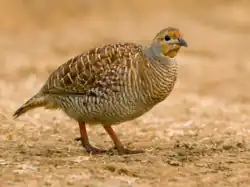 Frankolin indyjski (O. pondicerianus) | |||
| Systematyka | |||
| Domena | |||
|---|---|---|---|
| Królestwo | |||
| Typ | |||
| Podtyp | |||
| Gromada | |||
| Podgromada | |||
| Infragromada | |||
| Rząd | |||
| Rodzina | |||
| Podrodzina | |||
| Plemię | |||
| Rodzaj |
Ortygornis | ||
| Typ nomenklatoryczny | |||
|
Tetrao pondicerianus J.F. Gmelin, 1789 | |||
| Synonimy | |||
|
| |||
| Gatunki | |||
| |||
Ortygornis – rodzaj ptaków z podrodziny bażantów (Phasianinae) w obrębie rodziny kurowatych (Phasianidae).
Zasięg występowania
Rodzaj obejmuje gatunki występujące w Afryce, na Bliskim Wschodzie i w południowej Azji[4].
Morfologia
Długość ciała 30–38 cm; masa ciała samic 200–375 g, samców 255–510 g[5].
Systematyka
Etymologia
- Ortygornis: gr. ορτυξ ortux, ορτυγος ortugos „przepiórka”; ορνις ornis, ορνιθος ornithos „ptak”[6].
- Dendroperdix: gr. δενδρον dendron „drzewo”; περδιξ perdix, περδικος perdikos „kuropatwa”[7]. Typ nomenklatoryczny: Perdix sephaena A. Smith, 1836.
- Limnocolinus: gr. λιμνη limnē „bagno”; rodzaj Colinus Goldfuss, 1820 (przepiór)[8]. Typ nomenklatoryczny: Perdix gularis Temminck, 1815.
Podział systematyczny
Gatunki O. pondicerianus i O. gularis zostały przeniesione z rodzaju Francolinus, natomiast gatunek O. sephaena z monotypowego rodzaju Dendroperdix; w takim ujęciu do rodzaju należą następujące gatunki[9]:
- Ortygornis sephaena (A. Smith, 1836) – frankolin czubaty
- Ortygornis pondicerianus (J.F. Gmelin, 1789) – frankolin indyjski
- Ortygornis gularis (Temminck, 1815) – frankolin bagienny
Przypisy
- ↑ H.G.L. Reichenbach: Avium systema naturale. Das natürliche system der vögel mit hundert tafeln grösstentheils original-abbildungen der bis jetzt entdecken fast zwölfhundert typischen formen. Vorlaüfer einer iconographie der arten der vögel aller welttheile. Dresden und Leipzig: Expedition der vollständigsten naturgeschichte, 1850, s. xxviii. (niem.).
- ↑ A. Roberts. A review of the nomenclature of South African birds. „Annals of the Transvaal Museum”. 8 (4), s. 194, 1922. (ang.).
- ↑ T.M. Crowe, E.H. Harley, M.B. Jakutowicz, J. Komen & A.A. Crowe. Phylogenetic, taxonomic and biogeographical implications of genetic, morphological, and behavioral variation in francolins. „The Auk”. 109 (1), s. 37, 1992. DOI: 10.2307/4088264. (ang.).
- ↑ F. Gill, D. Donsker & P. Rasmussen (redaktorzy): Pheasants, partridges & francolins. IOC World Bird List: Version 13.1. [dostęp 2023-04-21]. (ang.).
- ↑ D.W. Winkler, S.M. Billerman & I.J. Lovette, Pheasants, Grouse, and Allies (Phasianidae), version 1.0, [w:] S.M. Billerman, B.K. Keeney, P.G. Rodewald & T.S. Schulenberg (redaktorzy), Birds of the World, Ithaca, NY: Cornell Lab of Ornithology, 2020, DOI: 10.2173/bow.phasia1.01 [dostęp 2023-04-21] (ang.).

- ↑ The Key to Scientific Names ↓, Ortygornis [dostęp 2018-09-09].
- ↑ The Key to Scientific Names ↓, Dendroperdix [dostęp 2023-04-21].
- ↑ The Key to Scientific Names ↓, Limnocolinus [dostęp 2018-09-09].
- ↑ Systematyka i nazwy polskie za: P. Mielczarek & M. Kuziemko: Plemię: Gallini Billberg, 1828 (wersja: 2024-09-29). [w:] Kompletna lista ptaków świata [on-line]. Instytut Nauk o Środowisku Uniwersytetu Jagiellońskiego. [dostęp 2024-12-29].
Bibliografia
- The Key to Scientific Names, J.A. Jobling (red.), [w:] Birds of the World, S.M. Billerman et al. (red.), Cornell Lab of Ornithology, Ithaca (ang.).