Parkesia
| Parkesia[1] | |||
| Sangster, 2008[2] | |||
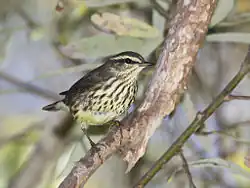 Lasówka nadwodna (P. noveboracensis) | |||
| Systematyka | |||
| Domena | |||
|---|---|---|---|
| Królestwo | |||
| Typ | |||
| Podtyp | |||
| Gromada | |||
| Podgromada | |||
| Infragromada | |||
| Rząd | |||
| Podrząd | |||
| Rodzina | |||
| Rodzaj |
Parkesia | ||
| Typ nomenklatoryczny | |||
|
Motacilla noveboracensis J.F. Gmelin | |||
| Gatunki | |||
| |||
Występowanie
Rodzaj obejmuje gatunki występujące w Ameryce Północnej[3], zimą także w północnej części Ameryki Południowej[4].
Morfologia
Długość ciała 15–15,5 cm, masa ciała 13,8–26 g[4].
Systematyka
Etymologia
Nazwa rodzajowa honoruje dr. Kennetha Parkesa (1922–2007), amerykańskiego ornitologa[5].
Motacilla noveboracensis J.F. Gmelin
Podział systematyczny
Takson ostatnio wyodrębniony z Seiurus[6][7][8][9][10]. Do rodzaju należą następujące gatunki[11]:
- Parkesia motacilla (Vieillot, 1809) – lasówka potokowa
- Parkesia noveboracensis (J.F. Gmelin, 1789) – lasówka nadwodna
Przypisy
- ↑ Parkesia, [w:] Integrated Taxonomic Information System (ang.).
- ↑ G. Sangster. A new genus for the waterthrushes (Parulidae). „Bulletin of the British Ornithologists’ Club”. 128, s. 213, 2008. (ang.).
- ↑ F. Gill, D. Donsker & P. Rasmussen (red.): New World warblers, mitrospingid tanagers. IOC World Bird List (v10.2). [dostęp 2021-01-20]. (ang.).
- 1 2 J. Curson: Family Parulidae (New World Warblers). W: J. del Hoyo, A. Elliott, D.A. Christie: Handbook of the Birds of the World. Cz. 15: Weavers to New World Warblers. Barcelona: Lynx Edicions, 2010, s. 766–767. ISBN 978-84-96553-68-2. (ang.).
- ↑ parkesia, [w:] The Key to Scientific Names, J.A. Jobling (red.), [w:] Birds of the World, S.M. Billerman et al. (red.), Cornell Lab of Ornithology, Ithaca [dostęp 2021-12-27] (ang.).
- ↑ I.J. Lovette, E. Bermingham. What is a Wood-Warbler? Molecular characterization of a monophyletic Parulidae. „The Auk”. 119 (3), s. 695–714, 2002. (ang.).
- ↑ N.K. Klein, K.J. Burns, S.J. Hackett, C.S. Griffiths. Molecular phylogenetic relationships among the wood warblers (Parulidae) and historical biogeography in the Caribbean basin. „The Journal of Caribbean Ornithology”. Special Issue. 17, s. 3–17, 2004. (ang.).
- ↑ I.J. Lovette, W.M. Hochachka, Simultaneous effects of phylogenetic niche conservatism and competition on avian community structure, „Ecology”, 87 (7), 2006, S14–S28, DOI: 10.1890/0012-9658(2006)87[14:SEOPNC]2.0.CO;2 (ang.).
- ↑ J.T. Weir, E. Bermingham, D. Schluter. The Great American Biotic Interchange in birds. „Proceedings of the National Academy Sciences”. 106 (51), s. 21737–21742, 2009. DOI: 10.1073/pnas.0903811106. (ang.).
- ↑ I.J. Lovette, J.L. Pérez-Emán, J.P. Sullivan, R.C. Banks, I. Fiorentino, S. Córdoba-Córdoba, M. Echeverry-Galvis, F.K. Barker, K.J. Burns, J. Klicka, S.M. Lanyon, E. Bermingham. A comprehensive multilocus phylogeny for the wood-warblers and a revised classification of the Parulidae (Aves). „Molecular Phylogenetics and Evolution”. 57 (2), s. 753–770, 2010. DOI: 10.1016/j.ympev.2010.07.018. (ang.).
- ↑ Systematyka i nazwy polskie za: P. Mielczarek & M. Kuziemko: Rodzina: Parulidae Wetmore, Friedmann, Lincoln, Miller,AH, Peters,JL, van Rossem, Van Tyne & Zimmer,JT, 1947 – lasówki – New World wood warblers (wersja: 2024-07-02). [w:] Kompletna lista ptaków świata [on-line]. Instytut Nauk o Środowisku Uniwersytetu Jagiellońskiego. [dostęp 2025-03-31].