Strepera
| Strepera[1] | |||
| Lesson, 1831[2] | |||
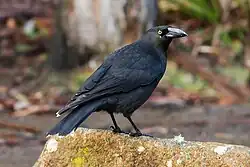 Kurawonga tasmańska (S. fuliginosa) | |||
| Systematyka | |||
| Domena | |||
|---|---|---|---|
| Królestwo | |||
| Typ | |||
| Podtyp | |||
| Gromada | |||
| Podgromada | |||
| Infragromada | |||
| Rząd | |||
| Podrząd | |||
| Rodzina | |||
| Podrodzina | |||
| Rodzaj |
Strepera | ||
| Typ nomenklatoryczny | |||
|
Coracias strepera Latham, 1790 (= Corvus graculinus Shaw, 1790) | |||
| Synonimy | |||
|
| |||
| Gatunki | |||
| |||
Strepera – rodzaj ptaków z podrodziny srokaczy (Cracticinae) w obrębie rodziny ostrolotów (Artamidae).
Zasięg występowania
Rodzaj obejmuje gatunki występujące w Australii i na Tasmanii[7].
Morfologia
Długość ciała 44–57 cm; masa ciała 243–500 g (samce są większe i cięższe od samic)[8].
Systematyka
Etymologia
- Barita (Barrita): gr. βαριτης baritēs „nieznany mały ptak” wspomniany przez Dionizego[9]. Typ nomenklatoryczny: Corvus graculinus Shaw, 1790.
- Strepera: epitet gatunkowy Coracias strepera Latham 1790; późnołac. streperus „głośny”, od łac. strepere „zrobić głośny hałas”[10].
- Coronica: nowołac. coronica „wronka”, zdrobnienie od gr. κορωνη korōnē „wrona”[11]. Typ nomenklatoryczny: Coronica fuliginosa Gould, 1837.
- Neostrepera: gr. νεος neos „nowy”; rodzaj Strepera Lesson, 1831 (kurawonga)[12]. Typ nomenklatoryczny: Strepera arguta[b] Gould, 1846.
Podział systematyczny
Do rodzaju należą następujące gatunki[7][13]:
- Strepera fuliginosa (Gould, 1837) – kurawonga tasmańska
- Strepera graculina (Shaw, 1790) – kurawonga czarna
- Strepera versicolor (Latham, 1801) – kurawonga zmienna
Uwagi
Przypisy
- ↑ Strepera, [w:] Integrated Taxonomic Information System (ang.).
- ↑ R.-P. Lesson: Traité d’ornithologie, ou, Tableau méthodique des ordres, sous-ordres, familles, tribus, genres, sous-genres et races d’oiseaux: ouvrage entièrement neuf, formant le catalogue le plus complet des espèces réunies dans les collections publiques de la France. T. 1. Bruxelles: Chez F.G. Levrault, 1831, s. 329. (fr.).
- ↑ G. Cuvier: Le règne animal distribué d’après son organisation, pour servir de base a l’histoire naturelle des animaux et d’introduction a l’anatomie comparée. T. 1. Paris: Chez Déterville, s. 340. (fr.).
- ↑ W. Swainson: On the natural history and classification of birds. Cz. 1. London: John Taylor, 1836, s. 256, seria: Cabinet cyclopaedia. Natural history. (ang.).
- ↑ J. Gould: A synopsis of the birds of Australia, and the adjacent Islands. London: John Gould, 1837–1838, s. ryc. i tekst. (ang.).
- ↑ G.M. Mathews. New genera. „Austral Avian Record”. 1 (8), s. 196, 1912–1913. (ang.).
- 1 2 F. Gill, D. Donsker & P. Rasmussen (redaktorzy), Bristlehead, butcherbirds, woodswallows, Mottled Berryhunter, ioras, cuckooshrikes [online], IOC World Bird List (v13.1) [dostęp 2023-06-15] (ang.).
- ↑ D.W. Winkler, S.M. Billerman & I.J. Lovette, Woodswallows, Bellmagpies, and Allies (Artamidae), version 1.0, [w:] S.M. Billerman, B.K. Keeney, P.G. Rodewald & T.S. Schulenberg (redaktorzy), Birds of the World, Cornell Lab of Ornithology, Ithaca, NY 2020, Strepera, DOI: 10.2173/bow.artami1.01 [dostęp 2025-04-05] (ang.).

- ↑ The Key to Scientific Names ↓, Barita [dostęp 2023-06-15].
- ↑ The Key to Scientific Names ↓, Strepera [dostęp 2023-06-15].
- ↑ The Key to Scientific Names ↓, Coronica [dostęp 2023-06-15].
- ↑ The Key to Scientific Names ↓, Neostrepera [dostęp 2023-06-15].
- ↑ Systematyka i nazwy polskie za: P. Mielczarek & M. Kuziemko, Podrodzina: Cracticinae Chenu & des Murs, 1853 – srokacze (wersja: 2024-06-23), [w:] Kompletna lista ptaków świata [online], Instytut Nauk o Środowisku Uniwersytetu Jagiellońskiego [dostęp 2025-04-05].
Bibliografia
- The Key to Scientific Names, J.A. Jobling (red.), [w:] Birds of the World, S.M. Billerman et al. (red.), Cornell Lab of Ornithology, Ithaca (ang.).