Turtur
| Turtur[1] | |||
| Boddaert, 1783[2] | |||
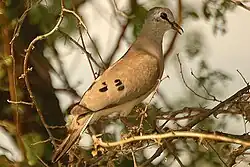 Turkaweczka czarnodzioba (T. abyssinicus) | |||
| Systematyka | |||
| Domena | |||
|---|---|---|---|
| Królestwo | |||
| Typ | |||
| Podtyp | |||
| Gromada | |||
| Podgromada | |||
| Infragromada | |||
| Rząd | |||
| Rodzina | |||
| Podrodzina | |||
| Rodzaj |
Turtur | ||
| Typ nomenklatoryczny | |||
|
Columba afra Linnaeus, 1766 | |||
| Synonimy | |||
|
| |||
| Gatunki | |||
| |||
Turtur – rodzaj ptaków z podrodziny treronów (Raphinae) w rodzinie gołębiowatych (Columbidae).
Zasięg występowania
Morfologia
Długość ciała 20–25 cm; masa ciała 50–135 g[7].
Systematyka
Etymologia
- Turtur: łac. turtur, turturis „turkawka”[8].
- Chalcopelia: gr. χαλκος khalkos „brąz, miedź”; πελεια peleia „gołąb”[9]. Gatunek typowy: Columba afra Linnaeus, 1766.
- Chalcoptera: gr. χαλκοπτερος khalkopteros „ze skrzydłami o metalicznym odcieniu, brązowoskrzydły”, od χαλκος khalkos „brąz, miedź”; πτερον pteron „skrzydło”[10]. Gatunek typowy: Columba tympanistria Temminck, 1809.
- Calopelia: gr. καλος kalos „piękny”; πελεια peleia „gołąb”[11]. Gatunek typowy: Columba puella Schlegel, 1848 (= Chalcopelia Brehmeri Hartlaub, 1865).
Podział systematyczny
Do rodzaju należą następujące gatunki[12]:
- Turtur chalcospilos (Wagler, 1827) – turkaweczka zielonoplamkowa
- Turtur abyssinicus (Sharpe, 1902) – turkaweczka czarnodzioba
- Turtur afer (Linnaeus, 1766) – turkaweczka modroplamkowa
- Turtur tympanistria (Temminck, 1809) – turkaweczka białoczelna
- Turtur brehmeri (Hartlaub, 1865) – turkaweczka modrogłowa
Przypisy
- ↑ Turtur, [w:] Integrated Taxonomic Information System (ang.).
- ↑ P. Boddaert: Table des planches enluminéez d'histoire naturelle de M. D’Aubenton: avec les denominations de M.M. de Buffon, Brisson, Edwards, Linnaeus et Latham, precedé d’une notice des principaux ouvrages zoologiques enluminés. Utrecht: 1783, s. 10. (fr.).
- ↑ Ch.-L. Bonaparte. Coup d’œil sur les Pigeons (quatrième partie). „Comptes rendus hebdomadaires des Séances de l’Académie des Sciences”. 40, s. 19, 1855. (fr.).
- ↑ G.E. Shelley. On a Collection of Birds from the Comoro Islands. „Proceedings of the Zoological Society of London”. 1879 (3), s. 678, 1879. (ang.).
- ↑ T. Salvadori: Catalogue of the Columbæ, or Pigeons, in the collection of the British Museum. Cz. 21. London: The Trustees, 1893, s. 522, seria: Catalogue of the Birds in the British Museum. (ang.).
- ↑ F. Gill, D. Donsker & P. Rasmussen (red.): IOC World Bird List (v11.2). [dostęp 2021-12-20]. (ang.).
- ↑ L.F. Baptista, P.W. Trail & H.M. Horblit: Family Columbidae (Pigeons and Doves). W: J. del Hoyo, A. Elliott & J. Sargatal: Handbook of the Birds of the World. Cz. 4: Sandgrouse to Cuckoos. Barcelona: Lynx Edicions, 1997, s. 149–150. ISBN 84-87334-22-9. (ang.).
- ↑ The Key to Scientific Names ↓, Turtur [dostęp 2025-02-28].
- ↑ The Key to Scientific Names ↓, Chalcopelia [dostęp 2025-02-28].
- ↑ The Key to Scientific Names ↓, Chalcoptera [dostęp 2025-02-28].
- ↑ The Key to Scientific Names ↓, Calopelia [dostęp 2025-02-28].
- ↑ Systematyka i nazwy polskie za: P. Mielczarek & M. Kuziemko: Podrodzina: Raphinae Wetmore, 1930 – trerony (wersja: 2024-09-29). [w:] Kompletna lista ptaków świata [on-line]. Instytut Nauk o Środowisku Uniwersytetu Jagiellońskiego. [dostęp 2025-02-28].
Bibliografia
- The Key to Scientific Names, J.A. Jobling (red.), [w:] Birds of the World, S.M. Billerman et al. (red.), Cornell Lab of Ornithology, Ithaca (ang.).