Tympanuchus
| Tympanuchus[1] | |||
| Gloger, 1841[2] | |||
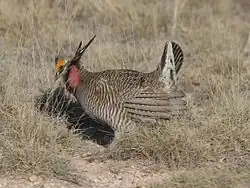 Preriokur mały (T. pallidicinctus) | |||
| Systematyka | |||
| Domena | |||
|---|---|---|---|
| Królestwo | |||
| Typ | |||
| Podtyp | |||
| Gromada | |||
| Podgromada | |||
| Infragromada | |||
| Rząd | |||
| Rodzina | |||
| Podrodzina | |||
| Plemię | |||
| Rodzaj |
Tympanuchus | ||
| Typ nomenklatoryczny | |||
|
Tetrao cupido Linnaeus, 1758 | |||
| Synonimy | |||
|
| |||
| Gatunki | |||
| |||
Tympanuchus – rodzaj ptaków z podrodziny bażantów (Phasianinae) w rodzinie kurowatych (Phasianidae).
Zasięg występowania
Rodzaj obejmuje gatunki występujące w Ameryce Północnej[9].
Morfologia
Długość ciała 38–48 cm; masa ciała samców 684–1090 g, samic 548–999 g[10].
Systematyka
Etymologia
- Tympanuchus: gr. τυμπανον tumpanon „kocioł”; ηχεω ēkheō „brzmieć” (por. εχω ekhō „mieć, posiadać”)[11].
- Cupidonia (Cupidinea): epitet gatunkowy Tetrao cupido Linnaeus, 1758; w mitologii rzymskiej Cupido (pol. Kupidyn) był bogiem miłości, synem Wenus[12]. Gatunek typowy: Tetrao cupido Linnaeus, 1758.
- Pedioecetes (Pediaecaetes, Pediocaetes, Pediocoetes): gr. εδιον pedion „równina, pole”, od πεδον pedon „ziemia”, od πους pous, ποδος podos „stopa”; οικητης oikētēs „mieszkaniec”, od οικεω oikeō „zamieszkiwać”[13]. Gatunek typowy: Tetrao phasianellus Linnaeus, 1758.
Podział systematyczny
Do rodzaju należą następujące gatunki[14]:
- Tympanuchus phasianellus (Linnaeus, 1758) – preriokur bażanci
- Tympanuchus cupido (Linnaeus, 1758) – preriokur dwuczuby
- Tympanuchus pallidicinctus (Ridgway, 1873) – preriokur mały
Przypisy
- ↑ Tympanuchus, [w:] Integrated Taxonomic Information System (ang.).
- ↑ C.W.L. Gloger: Gemeinnütziges Hand- und Hilfsbuch der Naturgeschichte. Für gebildete Leser aller Stände, besonders für die reifere Jugend und ihre Lehrer. Breslau: A. Schul, 1842, s. 396. (niem.).
- ↑ H.G.L. Reichenbach: Avium systema naturale. Das natürliche system der vögel mit hundert tafeln grösstentheils original-abbildungen der bis jetzt entdecken fast zwölfhundert typischen formen. Vorlaüfer einer iconographie der arten der vögel aller welttheile. Dresden und Leipzig: Expedition der vollständigsten naturgeschichte, 1850, s. xxix. (niem.).
- ↑ Baird 1858 ↓, s. xliv.
- ↑ Baird 1858 ↓, s. 625.
- ↑ D.G. Elliot. Remarks upon a Proposed Arrangement of the Family of Grouse, and New Genera Added. „Proceedings of the Academy of Natural Sciences of Philadelphia”. 16, s. 23, 1864. (ang.).
- ↑ E. Coues: A checklist of North American birds. Wyd. 2. Boston: Estes and Lauriat, 1882, s. 94. (ang.).
- ↑ F.E. Beddard: A text-book of zoogeography. Cambridge: University press, 1895, s. 97. (ang.).
- ↑ F. Gill, D. Donsker & P. Rasmussen (red.): IOC World Bird List (v11.2). [dostęp 2021-07-27]. (ang.).
- ↑ E. de Juana: Family Tetraonidae (Grouse). W: J. del Hoyo, A. Elliott & J. Sargatal: Handbook of the Birds of the World. Cz. 2: New World Vultures to Guineafowl. Barcelona: Lynx Edicions, 1994, s. 409. ISBN 84-87334-15-6. (ang.).
- ↑ The Key to Scientific Names ↓, Tympanuchus [dostęp 2025-03-10].
- ↑ The Key to Scientific Names ↓, Cupidonia [dostęp 2025-03-10].
- ↑ The Key to Scientific Names ↓, Pedioecetes [dostęp 2025-03-10].
- ↑ Systematyka i nazwy polskie za: P. Mielczarek, M. Kuziemko: Plemię: Tetraonini Leach, 1819 (wersja: 2024-09-29). [w:] Kompletna lista ptaków świata [on-line]. Instytut Nauk o Środowisku Uniwersytetu Jagiellońskiego. [dostęp 2025-03-10].
Bibliografia
- The Key to Scientific Names, J.A. Jobling (red.), [w:] Birds of the World, S.M. Billerman et al. (red.), Cornell Lab of Ornithology, Ithaca (ang.).
- S.F. Baird: Reports of explorations and surveys, to ascertain the most practicable and economical route for a railroad from the Mississippi River to the Pacific Ocean. Made under the direction of the secretary of war, in 1853-6. Cz. 9. Washington: A.O.P. Nicholson, Printer, 1858, s. i–lvi, 1–1005. (ang.).