Columba
| Columba[1] | |||||
| Linnaeus, 1758[2] | |||||
 Siniak (C. oenas) | |||||
| Systematyka | |||||
| Domena | |||||
|---|---|---|---|---|---|
| Królestwo | |||||
| Typ | |||||
| Podtyp | |||||
| Gromada | |||||
| Podgromada | |||||
| Infragromada | |||||
| Rząd | |||||
| Rodzina | |||||
| Podrodzina | |||||
| Plemię | |||||
| Rodzaj |
Columba | ||||
| Typ nomenklatoryczny | |||||
|
Columba oenas Linnaeus, 1758 | |||||
| |||||
| Gatunki | |||||
| |||||
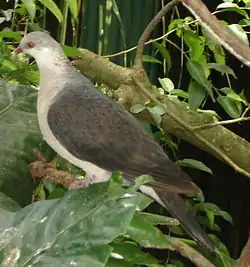
Columba – rodzaj ptaków z podrodziny gołębi (Columbinae) w rodzinie gołębiowatych (Columbidae).
Zasięg występowania
Rodzaj obejmuje gatunki występujące na całym świecie oprócz Antarktydy[31].
Morfologia
Długość ciała 25–45 cm; masa ciała 122–690 g[32].
Systematyka
Etymologia
- Columba (Columbus, Culumba, Columra): łac. columba „gołąb”[33].
- Palumbus: epitet gatunkowy Columba palumbus Linnaeus, 1758; łacińskie palumbus lub palumbes „grzywacz”[34]. Gatunek typowy: Columba palumbus Linnaeus, 1758.
- Alsocomus (Alsecomus, Alsoecomus, Alsaecomus): gr. αλσοκομος alsokomos „dozorca gaju”, od αλσος alsos, αλσεος alseos „gaj”; κομεω komeō „troszczyć się o” (por. κομμωσις kommōsis „upiększenie”)[35]. Gatunek typowy: Columba punicea Blyth, 1842.
- Dendrotreron: gr. δενδρον dendron „drzewo”; τρηρων trērōn, τρηρωνος trērōnos „gołąb”, od τρεω treō „uciekać ze strachu”[36]. Gatunek typowy: Columba hodgsonii Vigors, 1832.
- Janthoenas (Janthaenas, Ianthoenas): gr. ιανθος ianthos „w kolorze fioletowym, od ιον ion „fiolet”; οινας oinas, οιναδος oinados „gołąb”[37]. Gatunek typowy: Columba janthina Temminck, 1830.
- Lithoenas (Lithaenas): gr. λιθος lithos „kamień”; οινας oinas, οιναδος oinados „gołab”[38]. Gatunek typowy: Columba livia J.F. Gmelin, 1789.
- Stictoenas (Stictaenas, Strictoenas): gr. στικτος stiktos „cętkowany”, od στιζω stizō „tatuować”; οινας oinas, οιναδος oinados „gołąb”[39]. Gatunek typowy: Columba arquatrix Temminck, 1808.
- Taenioenas (Taeniaenas): gr. ταινια tainia „przepaska”; οινας oinas, οιναδος oinados „gołąb”[40]. Gatunek typowy: Columba albitorques Rüppell, 1837.
- Leucomeloena (Leucomelaena, Leucomelaina): gr. λευκος leukos „biały”; μελας melas, μελαινα melaina „czarny”; οινας oinas „gołąb”[41]. Gatunek typowy: Columba norfolciensis Latham, 1801 (= Columba leucomela Temminck, 1821).
- Trocaza: epitet gatunkowy Columba trocaz Heineken, 1829; lokalna, maderska nazwa Pombo trocaz „pierścieniowy gołąb” dla gołębia maderskiego, od łac. torques „obroża”[42]. Gatunek typowy: Columba trocaz Heineken, 1829.
- Livia: epitet gatunkowy Columba livia J.F. Gmelin, 1789; średniowiecznołac. livia „gołąb skalny”, od łac. livens, liventis „ołowianego koloru”, od livere „być niebieskawym”[43]. Gatunek typowy: Columba livia J.F. Gmelin, 1789.
- Palumboena (Palumbaena): rodzaj Palumbus Kaup, 1829 (gołąb); gr. οινας oinas, οιναδος oinados „gołąb”[44]. Gatunek typowy: Columba oenas Linnaeus, 1758.
- Turturoena (Turturaena, Turturoenas): łac. turtur, turturis „turkawka”; gr. οινας oinas, οιναδος oinados „gołąb”[45]. Gatunek typowy: Columba delegorguei Delegorgue, 1847.
- Peleioenas (Pelecoenas): gr. πελεια peleia „dziki gołąb”; οινας oinas, οιναδος oinados „gołab”[46]. Nowa nazwa dla Turturoena Bonaparte, 1854.
- Leucotaenia: gr. λευκος leukos „biały”; ταινια tainia „przepaska”[47]. Gatunek typowy: Columba unicincta Cassin, 1859.
- Coelotreron: gr. κοιλος koilos „pusty” (tj. znoszący jaja w otworach drzew); τρηρων trērōn, τρηρωνος trērōnos „gołąb”, od τρεω treō „uciekać ze strachu”[48]. Nowa nazwa dla Palumboena Bonaparte, 1854.
- Amauroenas: gr. αμαυρος amauros „ciemny”; οινας oinas, οιναδος oinados „gołąb”[49]. Gatunek typowy: Columba pollenii Schlegel, 1865.
- Dialiptila: gr. διαλυω dialuō „rozstać się”; πτιλον ptilon „pióro”[50]. Gatunek typowy: Columba guinea Linnaeus, 1758.
- Leucoenas: gr. λευκος leukos „biały”; οινας oinas, οιναδος oinados „gołąb”[51]. Gatunek typowy: Carpophaga grisea G.R. Gray, 1844 (= Columba argentina Bonaparte, 1857).
- Tryzusa (Trizusa): gr. τρυζω truzō „gruchać, szemrać” (por. τριζω trizō „ćwierkać”)[52]. Nowa nazwa dla Turturoena Bonaparte, 1854.
- Raperia: George Raper (1769–1797), por. Royal Navy, podróżnik, artysta z Afryki Południowej, Australii i Pacyfiku[53]. Gatunek typowy: †Raperia godmanae Mathews, 1915[a].
Podział systematyczny
Do rodzaju należą następujące gatunki[54]:
- Columba livia J.F. Gmelin, 1789 – gołąb skalny
- Columba rupestris Pallas, 1811 – gołąb górski
- Columba leuconota Vigors, 1831 – gołąb białobrzuchy
- Columba guinea Linnaeus, 1758 – gołąb okularowy
- Columba albitorques Rüppell, 1837 – gołąb białokryzy
- Columba oenas Linnaeus, 1758 – siniak
- Columba eversmanni Bonaparte, 1856 – gołąb brunatny
- Columba oliviae Stephenson Clarke, 1918 – gołąb somalijski
- Columba palumbus Linnaeus, 1758 – grzywacz
- Columba trocaz Heineken, 1829 – gołąb maderski
- Columba bollii Godman, 1872 – gołąb kanaryjski
- Columba junoniae E. Hartert, 1916 – gołąb laurowy
- Columba unicincta Cassin, 1859 – gołąb kongijski
- Columba arquatrix Temminck, 1808 – gołąb żółtooki
- Columba sjostedti Reichenow, 1901 – gołąb kameruński
- Columba thomensis Bocage, 1888 – gołąb kasztanowaty
- Columba pollenii Schlegel, 1865 – gołąb śniady
- Columba hodgsonii Vigors, 1832 – gołąb himalajski
- Columba albinucha Sassi, 1911 – gołąb pstrogłowy
- Columba pulchricollis Blyth, 1846 – gołąb jasnoszyi
- Columba elphinstonii (Sykes, 1832) – gołąb brązowogrzbiety
- Columba torringtoniae (Blyth & Kelaart, 1853) – gołąb liliowy
- Columba punicea Blyth, 1842 – gołąb jasnogłowy
- Columba argentina Bonaparte, 1857 – gołąb srebrzysty
- Columba palumboides (Hume, 1873) – gołąb siwogłowy
- Columba janthina Temminck, 1830 – gołąb czarny
- Columba versicolor von Kittlitz, 1832 – gołąb boniński – takson wymarły pod koniec XIX wieku[55]
- Columba jouyi (Stejneger, 1887) – gołąb srebrnokryzy – takson wymarły w XIX wieku[56]
- Columba vitiensis Quoy & Gaimard, 1830 – gołąb białogardły
- Columba leucomela Temminck, 1821 – gołąb białogłowy
- Columba pallidiceps (E.P. Ramsay, 1878) – gołąb żółtonogi
- Columba delegorguei Delegorgue, 1847 – gołąb szarogłowy
- Columba iriditorques Cassin, 1857 – gołąb lśniący
- Columba malherbii J. Verreaux & E. Verreaux, 1851 – gołąb zatokowy
- Columba thiriouxi J. Hume, 2011 – gołąb maurytyjski – takson wymarły około 1730 roku[57]
Uwagi
- ↑ Podgatunek C. vitiensis.
Przypisy
- ↑ Columba, [w:] Integrated Taxonomic Information System (ang.).
- ↑ C. Linnaeus: Systema naturae per regna tria naturae: secundum classes, ordines, genera, species, cum characteribus, differentiis, synonymis, locis. Wyd. 10. T. 1. Holmiae: Impensis Direct. Laurentii Salvii, 1758, s. 162. (łac.).
- ↑ M. Tunstall: Ornithologia Britannica. London: Author by J. Dixwell, 1771, s. [2]. (fr.).
- ↑ J.J. Kaup: Skizzirte Entwickelungs-Geschichte und natürliches System der europäischen Thierwelt: Erster Theil welcher die Vogelsäugethiere und Vögel nebst Andeutung der Entstehung der letzteren aus Amphibien enthält. Darmstadt: In commission bei Carl Wilhelm Leske, 1829, s. 107. (niem.).
- ↑ E. Blyth. Aves. „The journal of the Asiatic Society of Bengal”. 11 (1), s. 461, 1842. (ang.).
- ↑ B.H. Hodgson. Description of new Dove. „The Journal of the Asiatic Society of Bengal”. 12 (2), s. 937, 1843. (ang.).
- ↑ J.A. Wagner: Ornithology. W: Ray Society: Reports on zoology for 1843, 1844. London: Printed for the Ray society, 1847, s. 293. (ang.).
- 1 2 3 4 H.G.L. Reichenbach: Avium systema naturale. Das natürliche system der vögel mit hundert tafeln grösstentheils original-abbildungen der bis jetzt entdecken fast zwölfhundert typischen formen. Vorlaüfer einer iconographie der arten der vögel aller welttheile. Dresden und Leipzig: Expedition der vollständigsten naturgeschichte, 1850, s. xxv. (niem.).
- 1 2 Bonaparte 1854 ↓, s. 1104.
- ↑ Bonaparte 1854 ↓, s. 1106–1107.
- 1 2 3 4 5 6 Ch.-L. Bonaparte. Conspectus Systematis Ornithologie. „Annales des Sciences Naturelles, Zoologie”. Quatrième Série. 1, s. 140, 1854. (fr.).
- 1 2 Ch.-L. Bonaparte: Conspectus generum avium. T. 2. Lugduni Batavorum: Apud E.J. Brill, 1857, s. 45. (łac.).
- ↑ Des Murs 1854 ↓, s. 34, 40.
- ↑ Des Murs 1854 ↓, s. 33, 40.
- ↑ G.R. Gray: Catalogue of the genera and subgenera of birds contained in the British Museum. London: Printed by order of the Trustees, 1855, s. 99. (ang.).
- ↑ G.R. Gray: List of the specimens of birds in the collection of the British Museum. Cz. 4. London: printed by the order of the Trustees, 1856, s. 23. (ang.).
- ↑ J. Gould. On some Birds collected by Mr. John MacGillivray, the Naturalist attached to H. M. Surveying Ship Rattlesnake, and lately sent home by Capt. Denham, the Commander of the Expedition. „Proceedings of the Zoological Society of London”. 24, s. 136, 1856. (ang.).
- ↑ J. Cassin. Descriptions and Notes on Birds in the Collection of the Academy of Natural Sciences of Philadelphia and in the National Museum, Washington. „Proceedings of the Academy of Natural Sciences of Philadelphia”. 8, s. 254, 1856. (ang.).
- ↑ Ch.-L. Bonaparte. Additions et Corrections au Coup d’oeil sur ï Ordre des Pigeons, et à la partie correspondante du Conspectus Avium. „Comptes Rendus Hebdomadaires des Séances de l’Académie des Sciences”. 43, s. 838, 1856. (fr.).
- ↑ Reichenbach 1862 ↓, s. 52.
- ↑ Reichenbach 1862 ↓, s. 54.
- ↑ G. Hartlaub. Berichtignngen und Zusätze zu meinem „System der Ornithologie Westafrica’s.“. „Journal für Ornithologie”. 9, s. 266, 1861. (niem.).
- ↑ Reichenbach 1862 ↓, s. 167.
- ↑ Heine i Reichenow 1882–1890 ↓, s. 275.
- 1 2 Heine i Reichenow 1882–1890 ↓, s. 276.
- ↑ Salvadori 1893 ↓, s. 248.
- ↑ Salvadori 1893 ↓, s. 243.
- ↑ Salvadori 1893 ↓, s. 242.
- ↑ A.J.Ch. Dubois: Synopsis avium: nouveau manuel d’ornithologie. Cz. 2. Bruxelles: H. Lamertin, 1904, s. 753. (fr.).
- ↑ G.M. Mathews. Raperia godmanae. A new bird from Lord Howe Island, now extinct. „Austral Avian Record”. 3, s. 21, 1915–1919. (ang.).
- ↑ F. Gill, D. Donsker & P. Rasmussen (red.): IOC World Bird List (v14.2). [dostęp 2025-02-28]. (ang.).
- ↑ L.F. Baptista, P.W. Trail & H.M. Horblit: Family Columbidae (Pigeons and Doves). W: J. del Hoyo, A. Elliott & J. Sargatal: Handbook of the Birds of the World. Cz. 4: Sandgrouse to Cuckoos. Barcelona: Lynx Edicions, 1997, s. 113–117, 119–121, 131. ISBN 84-87334-22-9. (ang.).
- ↑ The Key to Scientific Names ↓, Columba [dostęp 2021-12-23].
- ↑ The Key to Scientific Names ↓, Palumbus [dostęp 2021-12-23].
- ↑ The Key to Scientific Names ↓, Alsocomus [dostęp 2021-12-23].
- ↑ The Key to Scientific Names ↓, Dendrotreron [dostęp 2021-12-23].
- ↑ The Key to Scientific Names ↓, Janthoenas [dostęp 2021-12-23].
- ↑ The Key to Scientific Names ↓, Lithoenas [dostęp 2021-12-23].
- ↑ The Key to Scientific Names ↓, Stictoenas [dostęp 2021-12-23].
- ↑ The Key to Scientific Names ↓, Taenioenas [dostęp 2021-12-23].
- ↑ The Key to Scientific Names ↓, Leucomeloena [dostęp 2021-12-23].
- ↑ The Key to Scientific Names ↓, Trocaz [dostęp 2021-12-23].
- ↑ The Key to Scientific Names ↓, Livia [dostęp 2021-12-23].
- ↑ The Key to Scientific Names ↓, Palumboena [dostęp 2021-12-23].
- ↑ The Key to Scientific Names ↓, Turturoena [dostęp 2021-12-23].
- ↑ The Key to Scientific Names ↓, Peleioenas [dostęp 2021-12-23].
- ↑ The Key to Scientific Names ↓, Leucotaenia [dostęp 2021-12-23].
- ↑ The Key to Scientific Names ↓, Coelotreron [dostęp 2021-12-23].
- ↑ The Key to Scientific Names ↓, Amauroenas [dostęp 2021-12-23].
- ↑ The Key to Scientific Names ↓, Dialiptila [dostęp 2021-12-23].
- ↑ The Key to Scientific Names ↓, Leucoenas [dostęp 2021-12-23].
- ↑ The Key to Scientific Names ↓, Tryzusa [dostęp 2021-12-23].
- ↑ The Key to Scientific Names ↓, Raperia [dostęp 2021-12-23].
- ↑ Systematyka i nazwy polskie za: P. Mielczarek & M. Kuziemko: Podrodzina: Columbinae Leach, 1819 – gołębie (wersja: 2024-09-29). [w:] Kompletna lista ptaków świata [on-line]. Instytut Nauk o Środowisku Uniwersytetu Jagiellońskiego. [dostęp 2025-02-28].
- ↑ BirdLife International, Columba versicolor, [w:] The IUCN Red List of Threatened Species 2018, wersja 2018-1 [dostęp 2018-09-19] (ang.).
- ↑ BirdLife International, Columba jouyi, [w:] The IUCN Red List of Threatened Species 2018, wersja 2018-1 [dostęp 2018-09-19] (ang.).
- ↑ BirdLife International, Columba thiriouxi, [w:] The IUCN Red List of Threatened Species 2018, wersja 2018-1 [dostęp 2018-09-19] (ang.).
Bibliografia
- Ch.-L. Bonaparte. Coup d’œil sur les Pigeons (troisième partie). „Comptes Rendus Hebdomadaires des Séances de l’Académie des Sciences”. 39, s. 1102–1112, 1854. (fr.).
- M.A.P.O. Des Murs: Première famille. - Tréroninés ou Colombars. W: J.-Ch. Chenu: Encyclopédie d’histoire naturelle; ou, traité complet de cette science d’après les travaux des naturalistes les plus éminents de tous les pays et de toutes les époques: Buffon, Daubenton, Lacépède, G. Cuvier, F. Cuvier, Geoffroy Saint-Hilaire, Latreille, De Jussieu, Brongniart, etc.. Cz. 6: Oiseaux. Paris: Maresq, 1854, s. 26–46. (fr.).
- H.G.L. Reichenbach: Die vollständigste Naturgeschichte des In- und Auslandes. Cz. 2: Columbariae: Megapodinae, Peristerinae, Columbinae, Alectorinae. Dresden und Leipzig: Expedition der Vollständigsten Naturgeschichte, 1862. (niem.).
- T. Salvadori: Catalogue of the Birds in the British Museum. Cz. 21: Columbæ, or Pigeons. London: Printed by order of the Trustees, 1893, s. 1–676. (ang.).
- F. Heine & A. Reichenow: Nomenclator Musei Heineani Ornithologici; Verzeichniss der Vogel-Sammlung des Kgl. Oberamtmanns Ferdinand Heine. Berlin: R. Friedländer & Sohn, 1882–1890, s. 1–373. (niem.).
- The Key to Scientific Names, J.A. Jobling (red.), [w:] Birds of the World, S.M. Billerman et al. (red.), Cornell Lab of Ornithology, Ithaca (ang.).