Dacelo
| Dacelo[1] | |||
| Leach, 1815[2] | |||
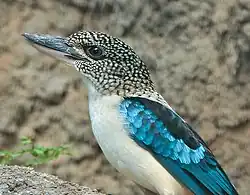 Przedstawiciel rodzaju – kukabura łuskowana (D. tyro) | |||
| Systematyka | |||
| Domena | |||
|---|---|---|---|
| Królestwo | |||
| Typ | |||
| Podtyp | |||
| Gromada | |||
| Podgromada | |||
| Infragromada | |||
| Rząd | |||
| Nadrodzina | |||
| Rodzina | |||
| Podrodzina | |||
| Rodzaj |
Dacelo | ||
| Typ nomenklatoryczny | |||
|
Alcedo gigantea Latham, 1790 (= Alcedo novaeguineae Hermann, 1783) | |||
| Synonimy | |||
|
| |||
| Gatunki | |||
| |||
Dacelo – rodzaj ptaków z podrodziny łowców (Halcyoninae) w rodzinie zimorodkowatych (Alcedinidae).
Zasięg występowania
Rodzaj obejmuje gatunki występujące na kontynencie australijskim, Nowej Gwinei i sąsiednich wyspach[11].
Morfologia
Długość ciała 28–42 cm; masa ciała samic 138–465 g, samców 110–450 g[11].
Systematyka
Etymologia
- Dacelo (Dacello): anagram nazwy rodzaju Alcedo Linnaeus, 1758 (zimorodek)[12].
- Paralcyon: gr. παρα para „blisko, pochodny”; rodzaj Alcyone Swainson, 1837 (zimorodek)[12]. Nowa nazwa dla Dacelo Leach, 1815.
- Agreutes: gr. αγρευτης agreutēs „łowca”, od αγρεω agreō „chwytać”[12]. Nowa nazwa dla Dacelo Leach, 1815.
- Choucalcyon: fr. Choucas „kawka”, od średniowiecznofr. Choucquas „kawka”, od oksyt. Caucala „wrona”; łac. alcyon, alcyonis „zimorodek”, od gr. αλκυων alkuōn, αλκυονος alkuonos „zimorodek”[12]. Gatunek typowy: Alcedo novaeguineae Hermann, 1783.
- Nycticeyx: gr. νυκτι- nukti- „nocny”, od νυξ nux, νυκτος nuktos „noc”; rodzaj Ceyx Lacépède, 1799 (zimorodek)[12]. Nowa nazwa dla Dacelo Leach, 1815.
- Monachalcyon: późnołac. monachus „mnich” (tj. zakapturzony), od gr. μοναχος monakhos „mnich”, od μονος monos „samotny”, od μοναχοω monakhoō „robić pojedynczo”[12]. Gatunek typowy: Dacelo gaudichaud Quoy & Gaimard, 1824 (= Dacelo gaudichaud Gaimard, 1823).
- Sauromarptis: gr. σαυρος sauros „jaszczurka”; μαρπτις marptis „chwytacz”, od μαρπτω marptō „chwytać”[12]. Gatunek typowy: Dacelo gaudichaud Quoy & Gaimard, 1824 (= Dacelo gaudichaud Gaimard, 1823).
- Clytoceyx: gr. κλυτος klutos „wspaniały, szlachetny”, od κλεω kleō „świętować”; rodzaj Ceyx Lacépède, 1799 (zimorodek)[12]. Gatunek typowy: Clytoceyx rex Sharpe, 1880.
- Capricia: fr. caprice „kaprys, fantazyjny, podnieta”[12]. Gatunek typowy: Dacelo tyro G.R. Gray, 1858.
Podział systematyczny
Do rodzaju należą następujące gatunki[13]:
Przypisy
- ↑ Dacelo, [w:] Integrated Taxonomic Information System (ang.).
- ↑ W.E. Leach: The Zoological Miscellany: being descriptions of new, or interesting animals. Cz. 2. London: Printed by B. McMillan for E. Nodder & Son and sold by all booksellers, 1815, s. 125. (ang.).
- ↑ C.W.L. Gloger. Etwas über einige ornithologische Gattungsbez nennungen. „Notizen aus dem Gebiete der Natur- und Heilkunde”. 16, s. kol. 278, 1827. (niem.).
- 1 2 G.J. Billberg: Synopsis Faunae Scandinaviae. T. 1. Cz. 2: Aves. Holmiae: Ex officina typogr. Caroli Deleen, 1828, s. tab. A. (łac.).
- ↑ R.-P. Lesson: Traité d’ornithologie, ou, Tableau méthodique des ordres, sous-ordres, familles, tribus, genres, sous-genres et races d’oiseaux: ouvrage entièrement neuf, formant le catalogue le plus complet des espèces réunies dans les collections publiques de la France. Bruxelles: Chez F.G. Levrault, 1831, s. 248. (fr.).
- ↑ C.W.L. Gloger: Gemeinnütziges Hand- und Hilfsbuch der Naturgeschichte. Für gebildete Leser aller Stände, besonders für die reifere Jugend und ihre Lehrer. Breslau: A. Schulz, 1842, s. 338. (niem.).
- ↑ Alcedineae. The King-fishers. – Les Martin-pêcheurs. – Die Eisvögel. W: H.G.L. Reichenbach: Handbuch der speciellen Ornithologie. Dresden und Leipzig: Expedition der Vollstèandigsten Naturgeschichte, 1851, s. iv, 37. (niem.).
- ↑ J. Cabanis, F. Heine: Museum Heineanum: Verzeichniss der ornithologischen Sammlung des Oberamtmann Ferdinand Heine, auf Gut St. Burchard vor Halberstadt. Cz. 2: Schreivögel. Halberstadt: In Commission bei R. Frantz, 1859–1860, s. 163. (niem.).
- ↑ R.B. Sharpe. Description of two remarkable new species of Kingfishers. „The Annals and Magazine of Natural History”. Fifth Series. 6, s. 231, 1880. (ang.).
- ↑ T. Iredale: Birds of New Guinea. T. 1. Melbourne: Australiana Society, Georgian House, 1956, s. 198. (ang.).
- 1 2 D.W. Winkler, S.M. Billerman & I.J. Lovette: Kingfishers (Alcedinidae), version 1.0. W: S.M. Billerman, B.K. Keeney, P.G. Rodewald & T.S. Schulenberg (red.): Birds of the World. Ithaca, NY: Cornell Lab of Ornithology, 2020. DOI: 10.2173/bow.alcedi1.01. [dostęp 2022-12-07]. (ang.).

- 1 2 3 4 5 6 7 8 9 Etymologia za: The Key to Scientific Names, J.A. Jobling (red.), [w:] Birds of the World, S.M. Billerman et al. (red.), Cornell Lab of Ornithology, Ithaca (ang.).
- ↑ Systematyka i nazwy polskie za: P. Mielczarek & M. Kuziemko: Podrodzina: Halcyoninae Vigors, 1825 – łowce (wersja: 2022-09-11). [w:] Kompletna lista ptaków świata [on-line]. Instytut Nauk o Środowisku Uniwersytetu Jagiellońskiego. [dostęp 2022-12-07].