Leiothlypis
| Leiothlypis[1] | |||
| Sangster, 2008[2] | |||
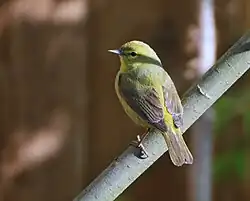 Lasówka zielonkawa (L. celata) | |||
| Systematyka | |||
| Domena | |||
|---|---|---|---|
| Królestwo | |||
| Typ | |||
| Podtyp | |||
| Gromada | |||
| Podgromada | |||
| Infragromada | |||
| Rząd | |||
| Podrząd | |||
| Rodzina | |||
| Rodzaj |
Leiothlypis | ||
| Typ nomenklatoryczny | |||
|
Sylvia peregrina A. Wilson | |||
| Gatunki | |||
| |||
Występowanie
Rodzaj obejmuje gatunki występujące w Ameryce Północnej[3], zimą także w północno-zachodniej części Ameryki Południowej[4].
Morfologia
Długość ciała 11–13,5 cm, masa ciała 5,1–18,4 g[4].
Systematyka
Etymologia
Nazwa rodzajowa jest połączeniem słów z języka greckiego: λειος leios – „równina” oraz θλυπις thlupis – nieznany mały ptak. W ornitologii thlypis oznacza albo cienkodziobą tanagrę lub, jak w tym przypadku, lasówkę[5].
Sylvia peregrina A. Wilson
Podział systematyczny
Takson wyodrębniony z Vermivora[2]. Część systematyków umieszczała gatunki z tego taksonu w Oreothlypis[6][7][8][9]. Do rodzaju należą następujące gatunki[10]:
- Leiothlypis peregrina (A. Wilson, 1811) – lasówka oliwkowa
- Leiothlypis celata (Say, 1822) – lasówka zielonkawa
- Leiothlypis crissalis (Salvin & Godman, 1889) – lasówka duża
- Leiothlypis luciae (J.G. Cooper, 1861) – lasówka rdzaworzytna
- Leiothlypis ruficapilla (A. Wilson, 1811) – lasówka rudogłowa
- Leiothlypis virginiae (S.F. Baird, 1860) – lasówka wirginijska
Przypisy
- ↑ Leiothlypis, [w:] Integrated Taxonomic Information System (ang.).
- 1 2 G. Sangster. A revision of Vermivora (Parulidae), with the description of a new genus. „Bulletin of the British Ornithologists’ Club”. 128 (3), s. 210, 2008. (ang.).
- ↑ F. Gill, D. Donsker & P. Rasmussen (red.): New World warblers, mitrospingid tanagers. IOC World Bird List (v10.2). [dostęp 2021-01-20]. (ang.).
- 1 2 J. Curson: Family Parulidae (New World Warblers). W: J. del Hoyo, A. Elliott, D.A. Christie: Handbook of the Birds of the World. Cz. 15: Weavers to New World Warblers. Barcelona: Lynx Edicions, 2010, s. 739–742. ISBN 978-84-96553-68-2. (ang.).
- ↑ Leiothlypis, [w:] The Key to Scientific Names, J.A. Jobling (red.), [w:] Birds of the World, S.M. Billerman et al. (red.), Cornell Lab of Ornithology, Ithaca [dostęp 2022-02-17] (ang.), [archiwum].
- ↑ I.J. Lovette, E. Bermingham. Mitochondrial perspective on the phylogenetic relationships of the Parula wood-warblers. „The Auk”. 118 (1), s. 211–215, 2001. DOI: 10.1093/auk/118.1.211. (ang.).
- ↑ I.J. Lovette, E. Bermingham. What is a Wood-Warbler? Molecular characterization of a monophyletic Parulidae. „The Auk”. 119 (3), s. 695–714, 2002. (ang.).
- ↑ N.K. Klein, K.J. Burns, S.J. Hackett, C.S. Griffiths. Molecular phylogenetic relationships among the wood warblers (Parulidae) and historical biogeography in the Caribbean basin. „The Journal of Caribbean Ornithology”. Special Issue. 17, s. 3–17, 2004. (ang.).
- ↑ I.J. Lovette, J.L. Pérez-Emán, J.P. Sullivan, R.C. Banks, I. Fiorentino, S. Córdoba-Córdoba, M. Echeverry-Galvis, F.K. Barker, K.J. Burns, J. Klicka, S.M. Lanyon, E. Bermingham. A comprehensive multilocus phylogeny for the wood-warblers and a revised classification of the Parulidae (Aves). „Molecular Phylogenetics and Evolution”. 57 (2), s. 753–770, 2010. DOI: 10.1016/j.ympev.2010.07.018. (ang.).
- ↑ Systematyka i nazwy polskie za: P. Mielczarek & M. Kuziemko: Rodzina: Parulidae Wetmore, Friedmann, Lincoln, Miller,AH, Peters,JL, van Rossem, Van Tyne & Zimmer,JT, 1947 – lasówki – New World wood warblers (wersja: 2024-07-02). [w:] Kompletna lista ptaków świata [on-line]. Instytut Nauk o Środowisku Uniwersytetu Jagiellońskiego. [dostęp 2025-03-30].