Lyciasalamandra
| Lyciasalamandra[1] | |||
| Veith & Steinfartz, 2004[2] | |||
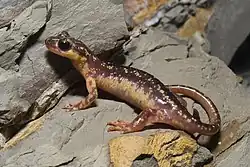 Przedstawiciel rodzaju – salamandra anatolijska (L. helverseni) | |||
| Systematyka | |||
| Domena | |||
|---|---|---|---|
| Królestwo | |||
| Typ | |||
| Podtyp | |||
| Gromada | |||
| Rząd | |||
| Rodzina | |||
| Podrodzina | |||
| Rodzaj |
Lyciasalamandra | ||
| Typ nomenklatoryczny | |||
|
Molge luschani Steindachner, 1891 | |||
| Gatunki | |||
| |||
Lyciasalamandra – rodzaj płazów ogoniastych z podrodziny Salamandrinae w rodzinie salamandrowatych (Salamandridae).
Zasięg występowania
Rodzaj obejmuje gatunki występujące na południowo-zachodnich wybrzeżach Turcji i pobliskich wyspach leżących na Morzu Egejskim (włącznie z Mejisti, Karpatos, Saria i Kasos w Grecji)[3].
Systematyka
Etymologia
Lyciasalamandra: Licja, starożytna rzymska prowincja w południowej Turcji; rodzaj Salamandra Laurenti, 1768[4].
Podział systematyczny
Do rodzaju należą następujące gatunki[3]:
- Lyciasalamandra antalyana (Başoğlu & Baran, 1976)
- Lyciasalamandra atifi (Başoğlu, 1967)
- Lyciasalamandra billae (Franzen & Klewen, 1987)
- Lyciasalamandra fazilae (Başoğlu & Atatür, 1975)
- Lyciasalamandra flavimembris (Mutz & Steinfartz, 1995)
- Lyciasalamandra helverseni (Pieper, 1963) – salamandra anatolijska[5]
- Lyciasalamandra luschani (Steindachner, 1891)
Przypisy
- ↑ Lyciasalamandra, [w:] Integrated Taxonomic Information System (ang.).
- ↑ Veith i Steinfartz 2004 ↓, s. 71.
- 1 2 D. Frost: Lyciasalamandra Veith and Steinfartz, 2004. [w:] Amphibian Species of the World 6.0, an Online Reference [on-line]. American Museum of Natural History. [dostęp 2022-03-18]. (ang.).
- ↑ Veith i Steinfartz 2004 ↓, s. 75.
- ↑ Praca zbiorowa: Zwierzęta: encyklopedia ilustrowana. Warszawa: Wydawnictwo Naukowe PWN, 2005, s. 423. ISBN 83-01-14344-4.
Bibliografia
- M. Veith & S. Steinfartz. When non-monophyly results in taxonomic consequences—the case of Mertensiella within the Salamandridae (Amphibia: Urodela). „Salamandra”. 40 (1), s. 67–80, 2004. (ang.).