Peromyscini
| Peromyscini | |||
| Cockerell & Printz, 1914[1] | |||
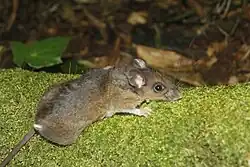 Przedstawiciel plemienia – myszak meksykański (Peromyscus mexicanus) | |||
| Systematyka | |||
| Domena | |||
|---|---|---|---|
| Królestwo | |||
| Typ | |||
| Podtyp | |||
| Gromada | |||
| Podgromada | |||
| Rząd | |||
| Podrząd | |||
| Infrarząd | |||
| Nadrodzina | |||
| Rodzina | |||
| Podrodzina | |||
| Plemię |
Peromyscini | ||
| Typ nomenklatoryczny | |||
|
Peromyscus Gloger, 1841 | |||
| Synonimy | |||
|
| |||
| Rodzaje | |||
| |||
Peromyscini – plemię ssaków z podrodziny nowików (Neotominae) w obrębie rodziny chomikowatych (Cricetidae).
Zasięg występowania
Plemię obejmuje gatunki występujące Ameryce Północnej i Środkowej[5].
Podział systematyczny
Do plemienia należą następujące rodzaje[6][7]:
- Podomys Osgood, 1909 – florydomyszak – jedynym żyjącym przedstawicielem jest Podomys loridanus (F.M. Chapman, 1889) – florydomyszak kserofilny
- Neotomodon Merriam, 1898 – myszowik – jedynym przedstawicielem jest Neotomodon alstoni Merriam, 1898 – myszowik górski
- Osgoodomys Hooper & Musser, 1964 – osgudek – jedynym przedstawicielem jest Osgoodomys banderanus (J.A. Allen, 1897) – osgudek meksykański
- Peromyscus Gloger, 1841 – myszak
- Megadontomys Merriam, 1898 – wielkomyszak
- Habromys Hooper & Musser, 1964 – meksykomysz
Uwagi
- ↑ Typ nomenklatoryczny: Hesperomys A. Murray, 1866 (= Peromyscus Gloger, 1841).
Przypisy
- ↑ T.D.A. Cockerell, L.I. Miller & M. Printz. The auditory ossicles of American rodents. „Bulletin of the American Museum of Natural History”. 33 (28), s. 359, 1914. (ang.).
- ↑ A. Murray: The Geographical Distribution of Mammals. London: Day and Son, 1866, s. 358. (ang.).
- ↑ G.G. Simpson. The principles of classification and a classification of mammals. „Bulletin of the American Museum of Natural History”. 85, s. 83, 1945. (ang.).
- ↑ P. Hershkovitz: Mice, land bridges and Latin American faunal interchange. W: R.L. Wenzel & V.J. Tipton (redaktorzy): Ectoparasites of Panama. Chicago: Field Museum of Natural History, 1966, s. 747. (ang.).
- ↑ C.J. Burgin, D.E. Wilson, R.A. Mittermeier, A.B. Rylands, T.E. Lacher & W. Sechrest: Illustrated Checklist of the Mammals of the World. Cz. 1: Monotremata to Rodentia. Barcelona: Lynx Edicions, 2020, s. 372, 376–386. ISBN 978-84-16728-34-3. (ang.).
- ↑ N. Upham, C. Burgin, J. Widness, M. Becker, C. Parker, S. Liphardt, I. Rochon & D. Huckaby: Treeview of Mammalian Taxonomy Hierarchy. [w:] ASM Mammal Diversity Database (Version 1.11) [on-line]. American Society of Mammalogists. [dostęp 2023-10-05]. (ang.).
- ↑ Nazwy polskie za: W. Cichocki, A. Ważna, J. Cichocki, E. Rajska-Jurgiel, A. Jasiński & W. Bogdanowicz: Polskie nazewnictwo ssaków świata. Warszawa: Muzeum i Instytut Zoologii PAN, 2015, s. 240–244. ISBN 978-83-88147-15-9. (pol. • ang.).
Identyfikatory zewnętrzne (takson):