Ternate (Małe Wyspy Sundajskie)
 | |
| Kontynent | |
|---|---|
| Państwo | |
| Archipelag | |
Położenie na mapie Indonezji  | |
 8°12′55″S 124°22′15″E/-8,215278 124,370833 8°12′55″S 124°22′15″E/-8,215278 124,370833 | |


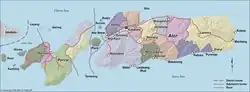
Ternate (indonez. Pulau Ternate), także Pura Kecil[1][2] – wyspa w Indonezji[3], jedna z wysp Alor, położona między Pantar a Alor[4].
Tę samą nazwę nosi wyspa Ternate w archipelagu Moluków[1][4].
Północny skrawek wyspy zamieszkują Alorczycy, posługujący się językiem alorskim z wielkiej rodziny austronezyjskiej[5]. Na południu używane są języki reta i blagar (grupa alor-pantar)[5][6][7].
Przypisy
- 1 2 Steinhauer 2010 ↓, przyp. 1, s. 280.
- ↑ Steinhauer 1977 ↓, s. 38.
- ↑ Pulau Ternate. GeoNames.org. [dostęp 2021-08-18]. (ang.).
- 1 2 Lonely Planet Indonesia, Lonely Planet, 2019, s. PT747 (Google Books), ISBN 978-1-78868-537-5, OCLC 1108554357 [dostęp 2021-08-18] (ang.).
- 1 2 Yunus Sulistyono, Interpreting oral history from the Alorese people in east Indonesia, „Revista Universidad y Sociedad”, 13 (4), 2021, s. 339–350, ISSN 2218-3620 [dostęp 2022-09-05] (ang.).
- ↑ M. Paul Lewis, Gary F. Simons, Charles D. Fennig (red.), Blagar, [w:] Ethnologue: Languages of the World, wyd. 18, Dallas: SIL International, 2015 [dostęp 2016-12-01] [zarchiwizowane z adresu 2016-12-01] (ang.).
- ↑ M. Paul Lewis, Gary F. Simons, Charles D. Fennig (red.), Reta, [w:] Ethnologue: Languages of the World, wyd. 18, Dallas: SIL International, 2015 [dostęp 2016-12-01] [zarchiwizowane z adresu 2016-12-01] (ang.).
Bibliografia
- Hein Steinhauer, 'Going' and 'coming' in the Blagar of Dolap, [w:] Soepomo Poedjosoedarmo (red.), Miscellaneous Studies in Indonesian and Languages in Indonesia, Part 3, Jakarta: Badan Penyelenggara Seri NUSA, Universitas Atma Jaya, 1977 (NUSA: Linguistic Studies in Indonesian and Languages in Indonesia 4), s. 38–48, OCLC 896429761 [dostęp 2023-05-31] (ang.).
- Hein Steinhauer, Pura when we were younger than today, [w:] Artiem M. Fiedorczuk, Swietłana F. Czlenowa (red.), Olga W. Biełowa (red. nauk.), Studia Anthropologica: Sbornik statiej w czestʹ prof. M.A. Czlenowa, Moskwa–Ijerusalim: Mosty kultury/Gieszarim, 2010, s. 261–283, ISBN 978-5-93273-319-5, OCLC 713785869 (ang.).