Skąpoogonki
| Pnoepygidae[1] | |||
| Gelang, Cibois, Pasquet, Olsson, Alström & Ericson, 2009 | |||
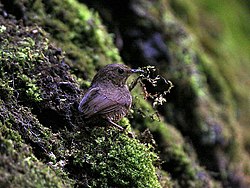 Skąpoogonek płowy (Pnoepyga albiventer) | |||
| Systematyka | |||
| Domena | |||
|---|---|---|---|
| Królestwo | |||
| Typ | |||
| Podtyp | |||
| Gromada | |||
| Podgromada | |||
| Infragromada | |||
| Rząd | |||
| Podrząd | |||
| Rodzina |
skąpoogonki | ||
| Typ nomenklatoryczny | |||
|
Tesia albiventer Hodgson | |||
| Rodzaje | |||
|
| |||
Skąpoogonki[4] (Pnoepygidae) – monotypowa rodzina ptaków[5] z rzędu wróblowych (Passeriformes).
Występowanie
Morfologia
Długość ciała 7,5–10 cm, masa ciała 11–23 g[7].
Systematyka
Etymologia
Greckie πνοη pnoē – „dmuchanie” < πνεω pneō – „oddychać”; πυγη pugē – „kuper”[8].
Podział systematyczny
Do rodziny skąpoogonków należy jeden rodzaj – Pnoepyga[4][6], który wcześniej zaliczany był do tymaliowatych (Timaliidae)[7]. Ostatnie badania sugerują bliskie pokrewieństwo skąpoogonków z trzciniakami (Acrocephalidae), mimikami (Donacobiidae), madagaskarniczkami (Bernieridae) i świerszczakami (Locustellidae)[9][10]. Do rodzaju należą następujące gatunki[4]:
- Pnoepyga immaculata J. Martens & Eck, 1991 – skąpoogonek nepalski
- Pnoepyga pusilla Hodgson, 1845 – skąpoogonek mały
- Pnoepyga albiventer (Hodgson, 1837) – skąpoogonek płowy
- Pnoepyga formosana C. Ingram, 1909 – skąpoogonek tajwański
Przypisy
- ↑ Pnoepygidae, [w:] Integrated Taxonomic Information System (ang.).
- ↑ Pnoepyga, [w:] Integrated Taxonomic Information System [dostęp 2012-09-05] (ang.).
- ↑ B.H. Hodgson: The Origins of Himalayan Studies. W: J.E. Gray: The Zoological miscellany. Cz. 3. London: Treuttel, Wurtz, 1844, s. 82. (ang.).
- 1 2 3 Systematyka i nazwy polskie za: P. Mielczarek, M. Kuziemko: Rodzina: Pnoepygidae Gelang, Cibois, Pasquet, Olsson, Alström & Ericson, 2009 - skąpoogonki - Wren babblers/Cupwings (wersja: 2021-01-16). [w:] Kompletna lista ptaków świata [on-line]. Instytut Nauk o Środowisku Uniwersytetu Jagiellońskiego. [dostęp 2025-04-08].
- ↑ M. Gelang, A. Cibois, E. Pasquet, U. Olsson, P. Alström, P.G.P. Ericson. Phylogeny of babblers (Aves, Passeriformes): major lineages, family limits and classification. „Zoologica Scripta”. 38 (3), s. 226–236, 2009. DOI: 10.1111/j.1463-6409.2008.00374.x. (ang.).
- 1 2 F. Gill, D. Donsker & P. Rasmussen (red.): IOC World Bird List (v15.1). [dostęp 2025-04-08]. (ang.).
- 1 2 N.J. Collar, N. Robson: Family Timaliidae (Babblers). W: J. del Hoyo, A. Elliott, D.A. Christie (red.): Handbook of the Birds of the World. Cz. 12: Picathartes to Tits and Chickadees. Barcelona: Lynx Edicions, 2007, s. 176–177. ISBN 84-96553-42-6. (ang.).
- ↑ Pnoepyga, [w:] The Key to Scientific Names, J.A. Jobling (red.), [w:] Birds of the World, S.M. Billerman et al. (red.), Cornell Lab of Ornithology, Ithaca [dostęp 2025-04-08] (ang.).
- ↑ P. Alström, J. Fjeldså, S. Fregin, U. Olsson. Gross morphology betrays phylogeny: the Scrub Warbler Scotocerca inquieta is not a cisticolid. „Ibis”. 153 (1), s. 87–97, 2011. DOI: 10.1111/j.1474-919X.2010.01093.x. (ang.).
- ↑ Martin Irestedt, Magnus Gelang, George Sangster, Urban Olsson, Per G.P. Ericson, Per Alström. Neumann's Warbler Hemitesia neumanni (Sylvioidea): the sole African member of a Palaeotropic Miocene avifauna. „Ibis”. 153 (1), s. 78–86, 2011. DOI: 10.1111/j.1474-919X.2010.01084.x. (ang.).