Turkuśniki
| Irenidae[1] | |||
| Jerdon, 1863 | |||
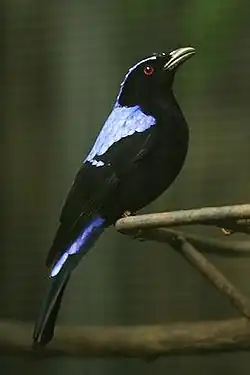 Samiec turkuśnika indyjskiego (Irena puella) | |||
| Systematyka | |||
| Domena | |||
|---|---|---|---|
| Królestwo | |||
| Typ | |||
| Podtyp | |||
| Gromada | |||
| Podgromada | |||
| Infragromada | |||
| Rząd | |||
| Podrząd | |||
| Rodzina |
turkuśniki | ||
| Typ nomenklatoryczny | |||
|
Coracias puella Latham, 1790 | |||
| Synonimy | |||
| |||
| Rodzaje | |||
|
| |||
Turkuśniki[5], turkuśnikowate[6] (Irenidae) – monotypowa rodzina ptaków z podrzędu śpiewających (Oscines) w rzędzie wróblowych (Passeriformes).
Zasięg występowania
Rodzina obejmuje gatunki występujące w strefie tropikalnej Azji[7][8].
Charakterystyka
Długość ciała 21,2–27,5 cm; masa ciała samców 56,6–96,1 g, samic 52–89,7 g[9][10].
Występuje u nich dymorfizm płciowy, samce mają kontrastowe niebiesko-czarne upierzenie, natomiast samice są bardziej matowe, błękitnawo-czarniawe lub turkusowo-czarniawe[9].
Żyją w lasach tropikalnych i na ich obrzeżach[9].
Żywią się głównie owocami, zwłaszcza figami, zjadają również owady i inne drobne bezkręgowce. Gniazdują na drzewach, składają 2–3 jaja[9].
Systematyka
Rodzina turkuśników najbliżej spokrewniona jest z zielenikami (Chloropseidae), niektórzy autorzy łączą je w jedną rodzinę[5].
Etymologia
- Irena: Ejrene (także: Irene lub Eirene) (gr. Ειρηνη Eirēnē), w mitologii greckiej bogini pokoju i obfitości[11].
- Glauconympha: gr. γλαυκος glaukos „niebiesko-szary, modry”; νυμφη numphē „nimfa”[12]. Gatunek typowy: Muscicapa cyanea Bagbie, 1834 (= Coracias puella Latham, 1790).
- Irenella: zdrobnienie nazwy rodzaju Irena Horsfield, 1821 (turkuśnik)[13]. Gatunek typowy: Irena cyanogastra Vigors, 1831.
Podział systematyczny
Do rodziny należy jeden rodzaj Irena z dwoma gatunkami[5]:
- Irena puella (Latham, 1790) – turkuśnik indyjski
- Irena cyanogastra Vigors, 1831 – turkuśnik czarnogrzbiety
Przypisy
- ↑ Irenidae, [w:] Integrated Taxonomic Information System (ang.).
- ↑ H.Ch. Oberholser. Diagnosis of a new pycnonotine family of Passeriformes. „Journal of the Washington Academy of Sciences”. 7, s. 539, 1917. (ang.).
- ↑ J.H. Riley. Note on the genus Irena Horsfield. „Proceedings of the Biological Society of Washington”. 40, s. 23, 1927. (ang.).
- ↑ T. Horsfield. Systematic Arrangement and Description of Birds from the Island of Java. „Transactions of the Linnean Society of London”. 13 (1), s. 153, 1822. (ang.).
- 1 2 3 Nazwy polskie za: P. Mielczarek & M. Kuziemko: Rodzina: Irenidae Jerdon, 1863 - turkuśniki - Fairy-bluebirds (wersja: 2024-07-02). [w:] Kompletna lista ptaków świata [on-line]. Instytut Nauk o Środowisku Uniwersytetu Jagiellońskiego. [dostęp 2025-04-11].
- ↑ P. Mielczarek & M. Kuziemko: Rodzina: Irenidae Jerdon, 1863 - turkuśnikowate - Fairy-bluebirds and leafbirds (wersja: 2015-05-27). [w:] Kompletna lista ptaków świata [on-line]. Instytut Nauk o Środowisku Uniwersytetu Jagiellońskiego. [dostęp 2015-12-25].
- ↑ F. Gill, D. Donsker & P. Rasmussen (red.): IOC World Bird List (v11.2). [dostęp 2022-01-19]. (ang.).
- ↑ Fairy-bluebirds (Irenidae). IBC: The Internet Bird Collection. [dostęp 2020-11-25]. [zarchiwizowane z tego adresu (2016-03-16)]. (ang.).
- 1 2 3 4 D.W. Winkler, S.M. Billerman & I.J. Lovette, Fairy-bluebirds (Irenidae), version 1.0, [w:] S.M. Billerman, B.K. Keeney, P.G. Rodewald & T.S. Schulenberg (red.), Birds of the World, Cornell Lab of Ornithology, Ithaca, NY 2020, DOI: 10.2173/bow.irenid1.01 [dostęp 2025-04-11] (ang.).

- ↑ D. Wells: Family Irenidae (Fairy-bluebirds). W: J. del Hoyo, A. Elliott & D.A. Christie: Handbook of the Birds of the World. Cz. 10: Cuckoo-shrikes to Thrushes. Barcelona: Lynx Edicions, 2005, s. 276–277. ISBN 84-87334-72-5. (ang.).
- ↑ Irena, [w:] The Key to Scientific Names, J.A. Jobling (red.), [w:] Birds of the World, S.M. Billerman et al. (red.), Cornell Lab of Ornithology, Ithaca [dostęp 2022-01-19] (ang.).
- ↑ Glauconympha, [w:] The Key to Scientific Names, J.A. Jobling (red.), [w:] Birds of the World, S.M. Billerman et al. (red.), Cornell Lab of Ornithology, Ithaca [dostęp 2022-01-19] (ang.).
- ↑ Irenella, [w:] The Key to Scientific Names, J.A. Jobling (red.), [w:] Birds of the World, S.M. Billerman et al. (red.), Cornell Lab of Ornithology, Ithaca [dostęp 2022-01-19] (ang.).